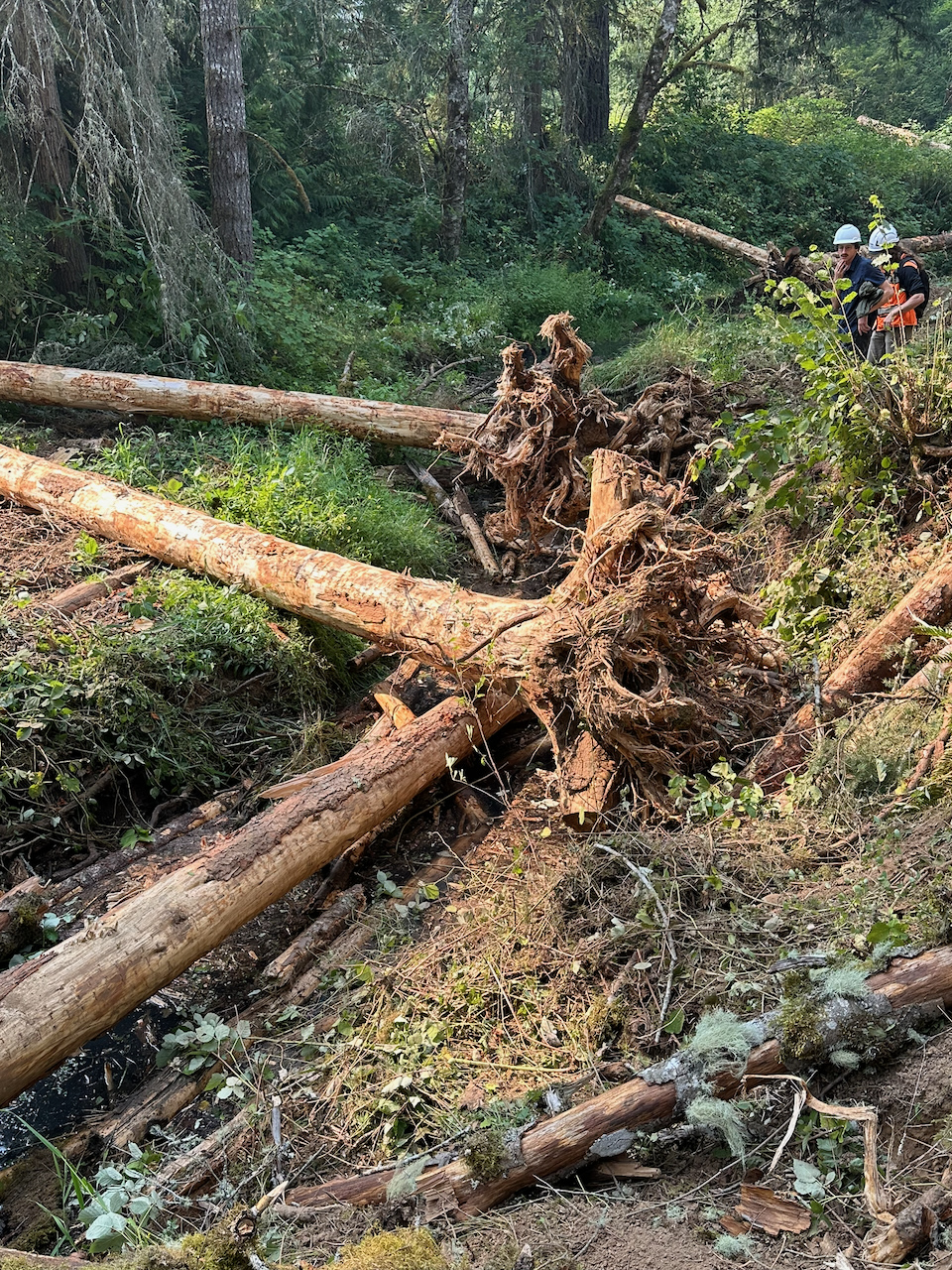
Beavers are doing the heavy lifting in a new watershed restoration project upstream of Oregon City, where crews placed 76 large fir logs along 2,000 feet of a tributary feeding Abernethy Creek in a project completed Aug. 4.
The Greater Oregon City Watershed Council finished the work at Jamestown Ranch, a 200-acre private property about 10 miles southeast of Oregon City, as part of a multi-year effort to cool water temperatures, boost salmon habitat and reduce the flash flooding that residents downstream have long dealt with.
"The biggest implementer of this project is not the excavators, it's not the design crews. It's the beavers," watershed restoration manager Andrew Robinson told The Oregonian.
The logs, complete with root balls still attached, give beavers already living along the creek a stable foundation to build bigger dams capable of withstanding seasonal floods. Robinson said heavy flooding last year blew out nearly all existing beaver dams, but by September the animals had rebuilt dams every 300 feet.
The project is the second phase of the council's Upper Abernethy Creek Enhancement Initiative. Phase one, completed in summer 2025, placed nearly 400 logs by helicopter along 3.93 miles of streams upstream of Beaver Lake.
Why it matters downstream
The Abernethy Creek watershed covers roughly 22,000 acres and flows toward Oregon City and the Willamette River. Executive director Tom Gaskill, who stands 6-foot-5, noted that the creek is little more than a trickle in mid-August but can rise to his chest by mid-January in a high water year.
Gaskill described Abernethy Creek as "flashy." It surges quickly during storms, drops gradually, then surges again. That erosive power causes problems where more people live, closer to Oregon City. Slowing water through the upper watershed gives it time to soak into the ground, recharging rural wells and easing flash flooding farther downstream.
The restored habitat will also benefit chinook and coho salmon, steelhead trout, cutthroat trout and Pacific lamprey by creating shallow riffles that add dissolved oxygen and deeper pools where fish can shelter during hot months.
Funding and what's next
The Jamestown Ranch phase cost roughly $212,000, funded by NOAA Fisheries ($90,000), the Oregon Watershed Enhancement Board ($100,000) and the Port Blakely Fund ($21,875). It is one of several projects in the upper watershed totaling about $850,000.
The watershed council plans to remove invasive Himalayan blackberry and plant up to 25,000 native trees and shrubs across 17 acres over the next four years, though it is still seeking funding to complete the full scope of that work. The council said it wants to expand revegetation beyond the current project boundaries.
Residents can reach the Greater Oregon City Watershed Council at 503-374-8279 or gocwc.org. No volunteer events have been announced.